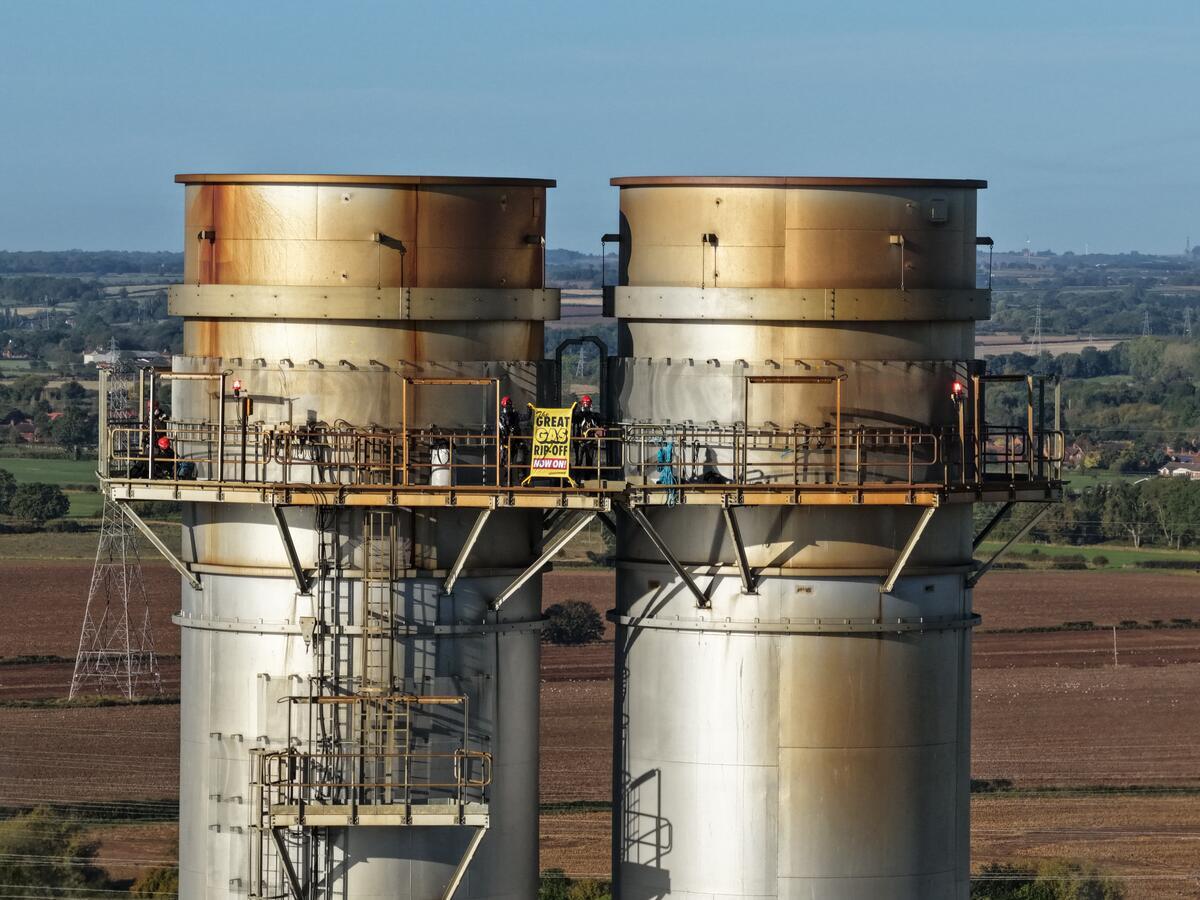
Greenpeace climbers scale the Bank of England. Green, not greed - well, it's a nice idea.
It's a cliché, but these are troubled economic times. And so it was that with great fanfare the government's pre-budget report announced a £50 billion recovery plan for the British economy.
Even better for those of us with an interest in the relative green-ness of our economy, Gordon Brown declared that about 10 per cent of the money would go to "environmentally important technologies and potentially jobs in the green industries". Sounds good. One MP said that the £50 billion was going to be used in "greening our economy as a whole".
Isn't it disappointing when something that sounds good turns out to be an illusion? According to a report we commissioned from the New Economics Foundation, any shoots of recovery from the recovery plan aren't going to be particularly green, because behind some creative accounting the government is only stumping up peanuts for the environment. It's not so much a 'green new deal' as a 'greenwashed new deal'.
What you're about to see is a case of the severely-shrinking numbers. Let's take Gordon Brown's claim that £50 billion is going to be pumped into the economy. First up, HSBC don't actually think the government are spending anything like £50 billion - they reckon it's closer to £20 billion. While we may have a few worries about the ability of bankers to do their sums these days, HSBC are backed up by the Environmental Audit Committee (EAC) - the government watchdogs on their own policies - who were similarly unimpressed with the claims.
Well, £20 billion is still a lot of money, even these days. But of that £20 billion, only £535 million is allocated for actual green stimulus, and according to the EAC the plan for how to spend it lacks coherence, hasn't worked out what the net environmental impact of the spending will be, and does little to transform our economy into a greener one.
Instead the Nef report shows that the green funding is piecemeal, inadequate and will have little effect on constraining carbon emissions in the UK. Most of the claimed £535 million was money that was already spoken for and was going to be spent anyway in future years - in other words, not new spending. Only about £120 million of the money is actually new.
The new money is mainly going to be spent on insulating increased numbers of houses to make them more energy efficient. That's a great thing to be doing, but on the scale of things it's fiddling while the planet burns. Don't believe me? Well, £120 million is seven times less than recent bonuses paid to staff at the Royal Bank of Scotland - the nearly-failed bank that is now largely owned by taxpayers like you and me. The car industry, which hasn't exactly been at the forefront of pushing forward environmental legislation, is getting £2.3 billion in loans out of the government money. (Plus a £27 million grant to build a new Land Rover, which probably isn't the greenest move of all time.)
The amount of new money for the environment isn't anywhere near the 10 per cent of the package promised by Gordon Brown. It isn't even 1 per cent - it's about 0.6 per cent. As a percentage of our gross domestic product (GDP), it's just 0.0083 per cent. Nicholas Stern recommended that to be truly facing up to climate change we should spend 0.8 per cent of our GDP - a hundred times as much - and he recently revised his estimate upwards.
You really realise how pathetic this is when you learn that the new and additional money the government are putting into 'greening our economy' will, at the start of 2012 (ie in two and a half years time) have only delayed the accumulation of UK emissions by about 6 and a half hours.
In other words, the total impact of the money the government is stumping up for the environment means that by 2012, we'll have bought ourselves about half a day's worth of emissions reductions. And I hate to be the voice of scepticism, but in the face of the environmental challenges we face, that's just rubbish.