Search
GP Worldwide
RSS
Creative Commons
TAKE ACTION
Recent entries
- Miliband's new department - what does it mean for the climate?
- Google going green?
- Where cattle herds go, deforestation follows
- How to fix the UK's renewables strategy
- Flashmob to stop London City Airport expansion
- End of a short-haul era?
- Opening up the Greenpeace photo library
- The Climate Rush is coming to suffragette city
- Turkish investors turn away from nuclear
- Trains, planes and Tory party policy
Brown must get a grip... we should be leading the pack on clean energy
Posted by John Sauven on 25 March 2008.
If new coal is the answer, Mr Brown's asking the wrong questions
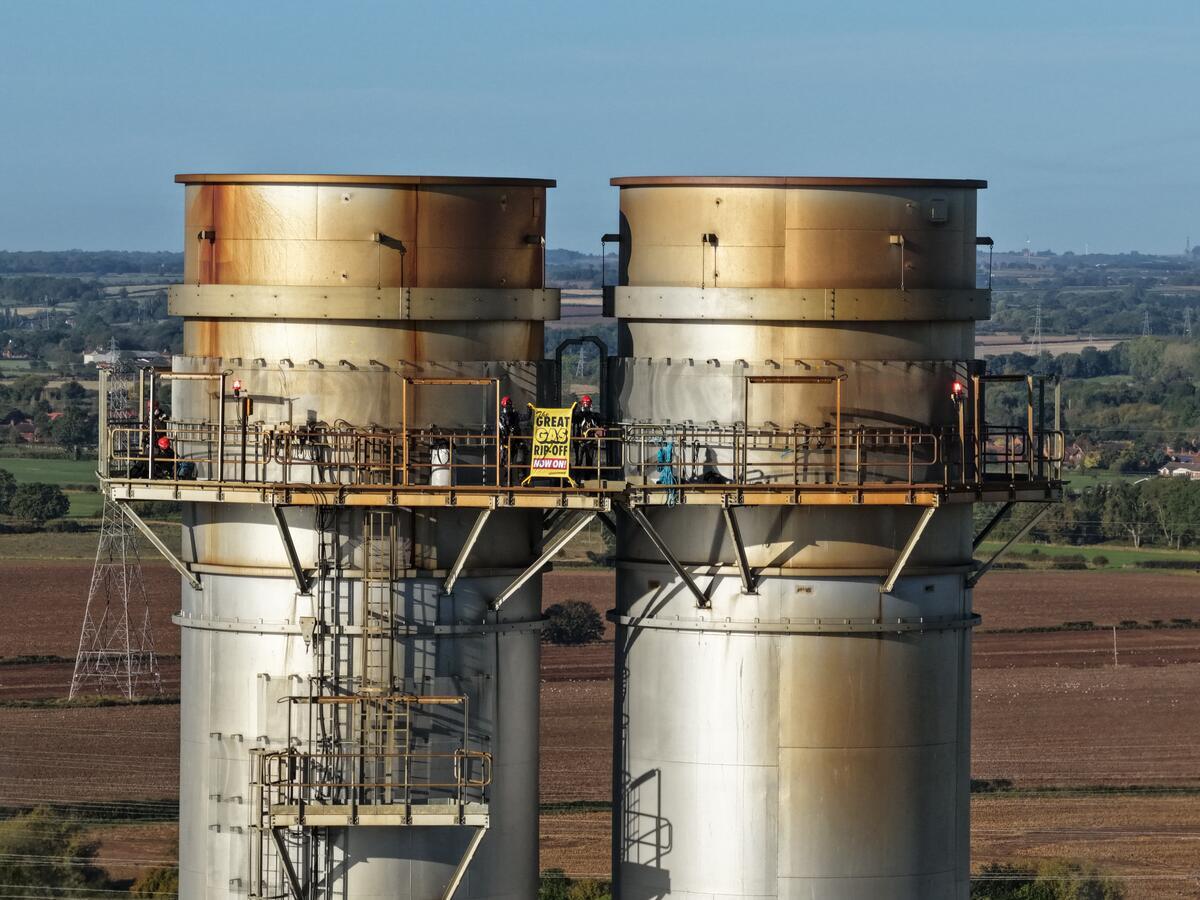
Kingsnorth exposes a government energy strategy in disarray. One week the Prime Minister commits the UK to generating around 40 per cent of its electricity from renewables, the next his Business Secretary sings the praises of the most carbon-intensive form of power generation around. We can only hope that John Hutton's words were an attempt to stake out his territory in the Cabinet, not a wider signal of government intent.
There is a serious split in the government over this issue. The disagreement centres on a technical detail but adds to a growing sense that the only way this problem can be properly dealt with is for the Cabinet to take a fresh look at its entire coal strategy. Carbon Capture and Storage (CCS) technology is still many years away, and to allow unabated plants before it is ready would fatally undermine our chances of cutting emissions. Kingsnorth alone would emit more than eight million tonnes of CO2 every year until CCS can be implemented. If Gordon Brown fails to get a grip on this problem, we could be landed with a new generation of massive carbon albatrosses.
But there is a solution. If the government is so eager to escape the messy implications of a public inquiry, it should stick to its word. John Hutton recently announced that the UK has the capacity to generate a massive 33GW of renewable electricity from offshore wind turbines alone in the next 10 years or so, easily negating the need for new coal. With the best renewable energy resources in the whole of Europe, we should be leading the pack when it comes to clean energy.
Instead of betting the ranch on an unproven technology with massive risks, the government should start implementing the solutions that are staring it in the face.


Fastest way to reduce CO2 emissions
Convert every building in UK to using Solar Water Heaters, the Chinese have 52,000 MW installed. Hot water is something like 3 times as energy using as electricity used for power, too much electricity is just used for water heating
The village of Orleton, where I live, comprising some 235 houses and a few industrial premises has just conducted an energy survey covering 2007.
One resident has logged that some 1400 hours of worthwhile solar energy was received by his Solar Water Heater during the year. He uses no electricity for water heating.during that period.
What is now to be explored is whether a project could be set on to install Solar Water Heating on all houses in the village as a community effort, with exterior funding and some form of "lease" basis, so that households pay the finance house or whoever a "rent" for the installation. I may have found a finance source see www.sunrisegf.com
The key to the above is how one can both get the benefit of the grants available, AND the depreciation allowances for equipment against profits tax liabilities. Which could materially alter the economics of the project. www.grunweb.org.uk