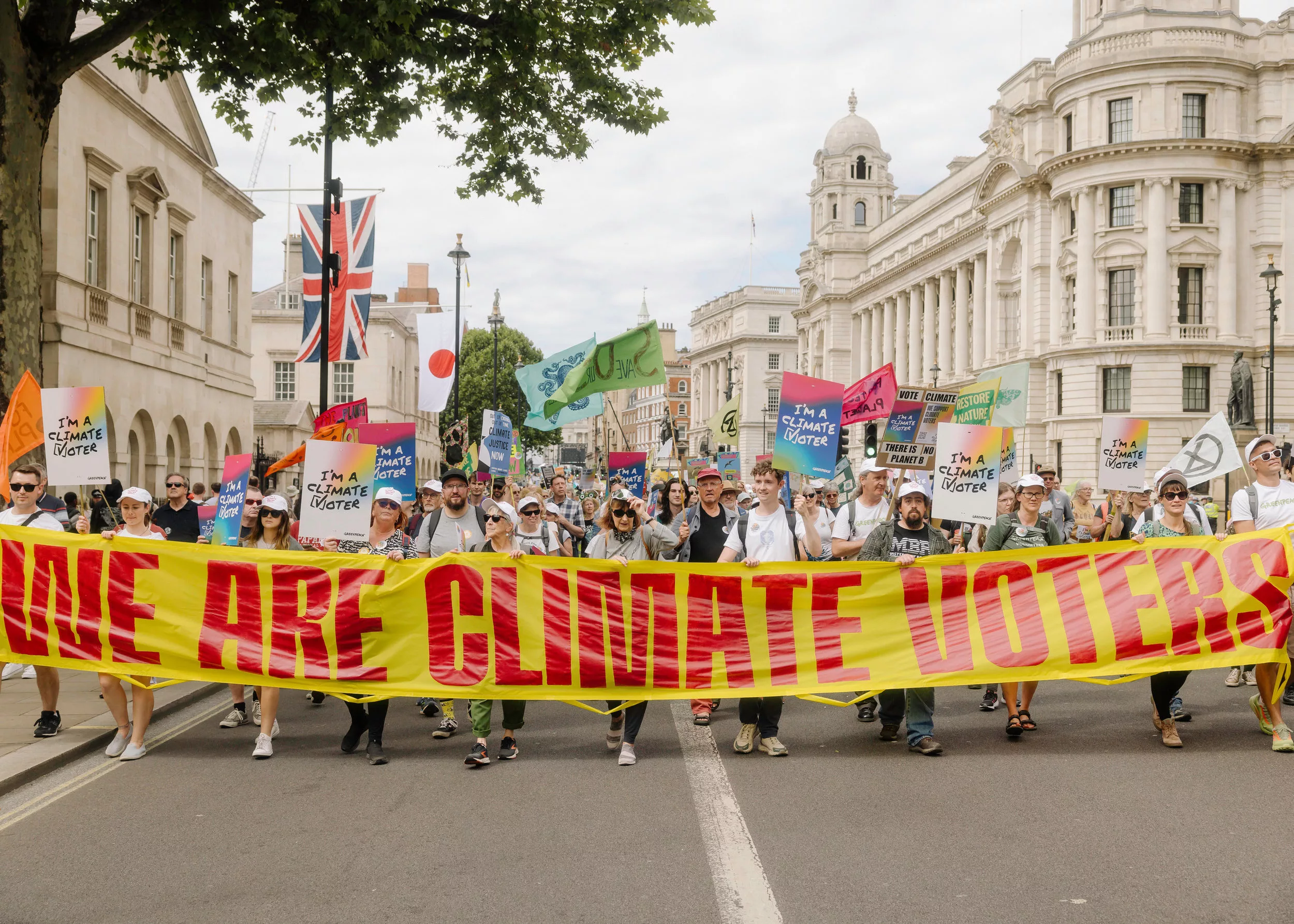
I am bathed in the warm glow of the righteous, for not only did I march with them, but I marched in the rain. Once you've made the decision, a little bit of meteorological adversity boosts everyone's sense of camaraderie. Apart, that is, from my fair-weather 'friend' Richard, who buggered off to the pub about ten minutes in, and is therefore the worst sort of part-timer and highly deserving of public contempt and derision. I try to do my bit.
So, apart from Richard the faithless, we were all there to send a message to Bali, where our glorious leaders are trying to save us all from climate Armageddon without imperilling the ability of large companies to make more money. Fortunately, climate change was recently reclassified from environmental disaster to business opportunity. Phew.
Well, the good news is that the march worked spectacularly well - around seven thousand people trudged through the rain on Saturday, and then on Sunday I learnt that we were getting 7,000 new off shore wind turbines. This is splendid, exactly what I was hoping for when Brown was elected. Real, responsive, proportional democracy. One man, one vote, one placard, one turbine. I'm going to call mine Phil, in honour of the chap who organised the march.
There will be those, of course, who cynically claim that the 7,000 new turbines have nothing to do with my brave band of soggy greens. They will claim it has more to do with climate change being re-zoned as an inward-investment area. There is, I suppose, a possibility that this is what Naomi Klein calls 'disaster capitalism'.
There's more to this idea than just the obvious point that destroying lots of stuff creates a business opportunity for the construction industry - there are also political, social and cultural systems which can be destroyed in times of crisis, and they too represent a business opportunity. The private sector isn't going to step in and fund reconstruction without guarantees that they are investing in a sustainable environment (no, I mean a sustainable business environment, which is rarely the same thing), and sometimes that requires a little restructuring, often some privatisation, and occasionally a tiny bit of regime change.
Greenpeace think the off-shore wind plan is fantastic, which is why we suggested it in the first place, but motives do matter. You can't rely on people with their hearts set on money to always come up with the same answers as people wanting to save the world. If combating climate change is left to the wise men at meetings like Bali, it will be run on the principles of disaster capitalism, with emissions cuts, real or imagined, being used as a cover for expanding corporate control over our environment. Chunks of our atmosphere have already been given away to the main polluters under the EU emissions trading scheme to use as their private dustbins. Old environmental foes like the nuclear and GM industries have repackaged themselves as saviours of the climate. The fossil fuel giants are demanding tax revenue to clean up their operations, and there's a whole new environmental protection racket, demanding money with emissions - "nice trees you've got there, be a shame if anything were to happen to them...."
Your world is in the process of being remodelled, both by climate change and our responses to it. Government and industry have finally started to take a real interest - perhaps you should too? Richard?