- Press Release
Russian attacks raise nuclear risks from Chornobyl plant, Greenpeace report warns

Ahead of the 40th anniversary of the Chornobyl nuclear disaster, a new report commissioned by Greenpeace provides a detailed assessment of the extensive damage caused by a Russian drone attack on the site last year. The report warns that the drone attack is likely to have shortened the 100-year lifespan of the protective structure around the damaged nuclear reactor, and that ongoing attacks by Russia make it impossible to repair the damage in the near term.
On 14 February 2025, a Russian Geran-2 drone with a high-explosive warhead struck the roof of the New Safe Confinement (NSC) at the Chornobyl Nuclear Power Plant. The NSC acts as a protective shield, preventing radiation leaking from the ageing concrete sarcophagus encasing nuclear reactor 4. The report concludes that without urgent repairs to the NSC, the sarcophagus is at risk of collapse.
The drone attack ripped a 15 m2 hole in the roof of the NSC, with shrapnel causing additional damage across a 200 m2 area. Fires continued smouldering in the inner membrane layer of the NSC’s roof for three weeks after the attack, leading to a loss of humidity and temperature control. This could lead to corrosion and may reduce the 100-year design life of the structure if humidity control is not restored by 2030.
Russia’s ongoing attacks against Ukraine have hampered international efforts to fix the damage to the NSC, with the plant under constant threat from Russian missiles and drones, including loss of essential electrical power. Despite ongoing investigations and damage assessments, it will be nearly impossible to start the major engineering works needed at the site under current conditions.
The report’s author Eric Schmieman, a civil engineer who worked as a senior technical adviser on the original design and construction of the NSC, said: “It’s almost impossible for people to grasp the magnitude of the lethal conditions inside the Sarcophagus. Tons of highly radioactive nuclear fuel, dust and debris. My colleagues and I spent years investigating inside the ruins of Chornobyl reactor 4. We designed and built the New Safe Confinement to protect the environment and people of Ukraine and Europe. It is urgent that all measures are taken to find a way to restore as much of the critical functions of the facility as possible”.
Greenpeace plans to submit the report to the Office of the Prosecutor General of Ukraine as independent evidence of potential Russian war crimes.
Shaun Burnie, senior nuclear specialist at Greenpeace Ukraine said:
“In April 1986, Ukraine and the world suffered the worst nuclear disaster in history. Today, decades later, the radioactive hazards at Chornobyl remain – with all efforts being made to contain and manage its toxic legacy. These are incredibly complex challenges. The Russian drone strike has now increased the risk that the Sarcophagus will collapse before it can be carefully dismantled. Greenpeace has a simple and clear message: the Russian crime of attacking Chornobyl must be punished, including maximum sanctions against its nuclear agency, Rosatom”.
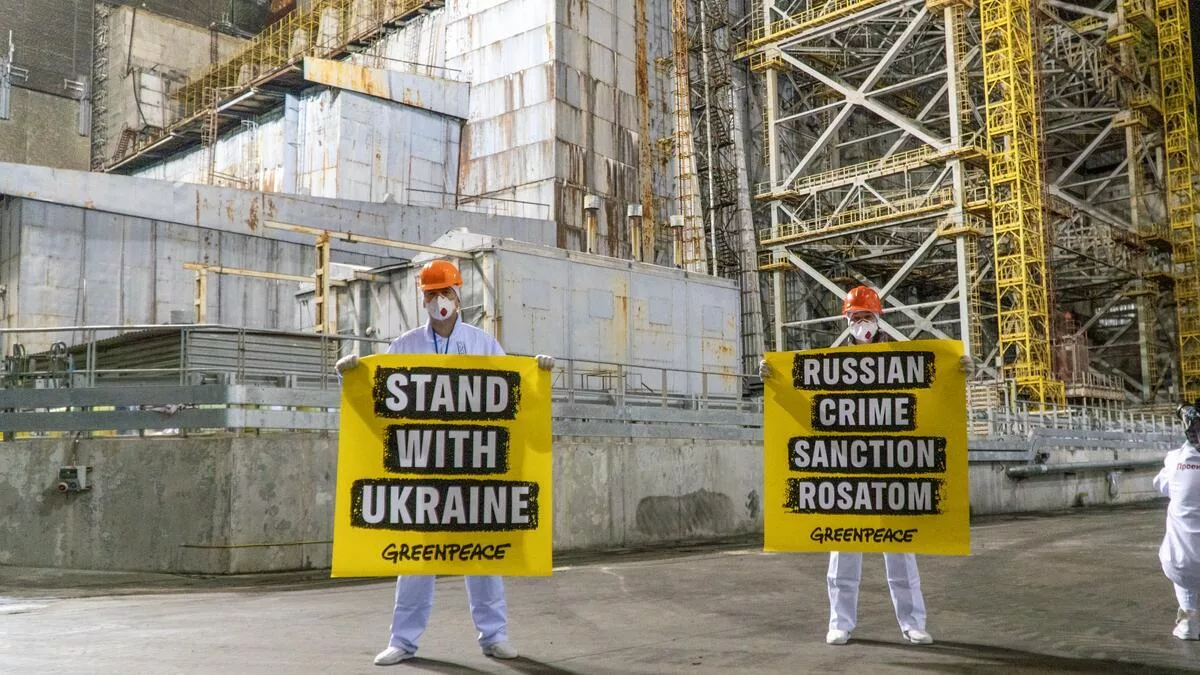
Activists from Greenpeace Ukraine held a protest inside the NSC calling for continued international support for Ukraine and for maximum sanctions against Russia’s state-owned nuclear agency Rosatom, which it believes to be complicit in the military campaign.
Ends
Contact: Greenpeace UK Press Office – press.uk@greenpeace.org or 020 7865 8255
Notes:
The full report, including executive summary, is available here.
Pictures and video of the Greenpeace protest at Chornobyl can be downloaded here.
The report author Eric Schmieman led the Battelle Memorial Institute team during the conceptual design of the NSC from 2001 to 2014. He served as the Manager of Environmental Safety and Health Department of the Chornobyl NSC Project Management Unit (PMU), and was the Senior Technical Advisor to the PMU Director. He lived in Slavutych, Ukraine from 2006 to 2013. While employed at Pacific Northwest National Laboratory, he contributed to projects funded by the US Department of Energy, the US Nuclear Regulatory Commission, the International Atomic Energy Administration, and other government agencies.
On the first day of Russia’s full-scale invasion, personnel from Rosatom, Russia’s state nuclear corporation, were part of the attack and occupation of Chornobyl nuclear plant. Four years later Rosatom still illegally occupies the Zaporizhzhia nuclear plant. Despite this, all efforts to secure international sanctions against Rosatom have been blocked, principally by Hungary and France, while billions of euros are traded in their contracts with Rosatom, directly funding Russia’s war against Ukraine.