GP Worldwide

Creative Commons

Email Print

Stocks crash – massive reserves desperately needed

Wasted lives? Bycatch from a beam trawler

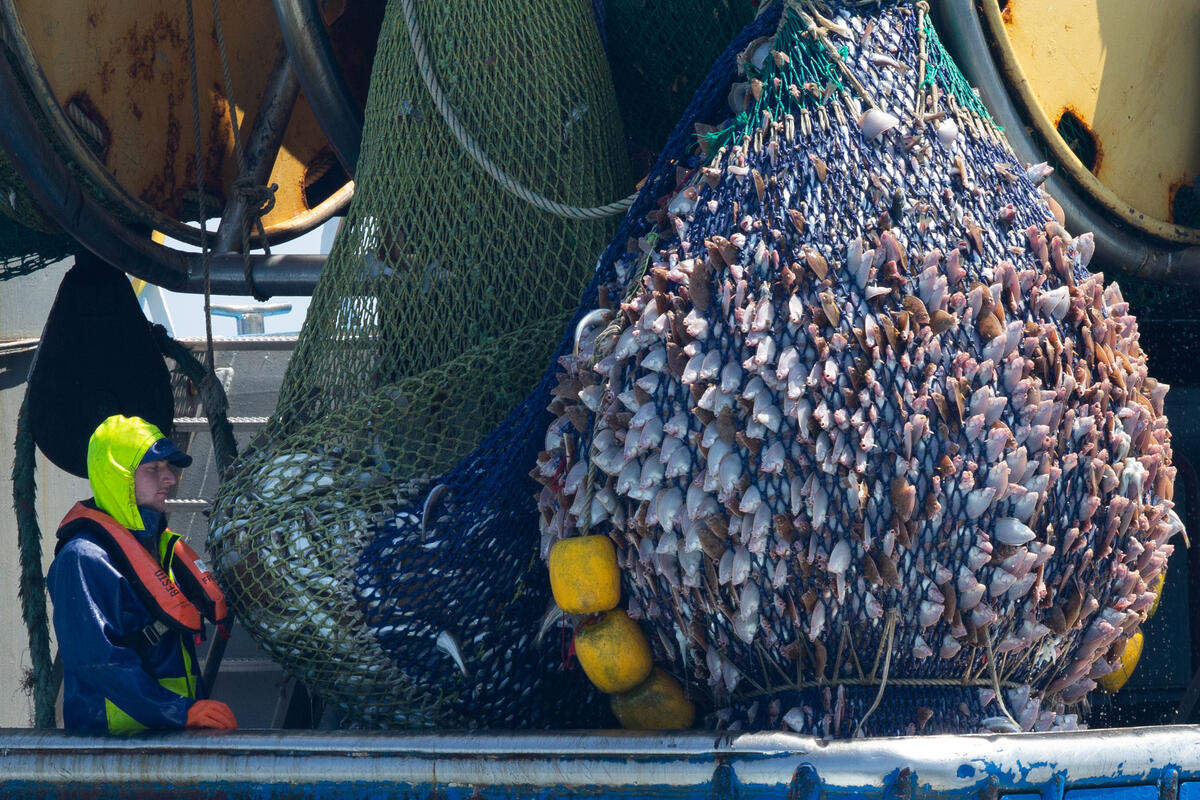
Our oceans are the last global commons, and as such are about as effectively regulated as Dodge City when the West was at it's wildest. As recently as 40 years ago they were considered to be an inexhaustible resource. No amount of fishing could possibly make a dent, it seemed, in the teeming mass of ocean life which constantly replenished itself. It was a one-sided arms race, with increasingly advanced fishing techniques maximizing catches: GPS; sonar; trawl nets big enough to catch a jumbo jet; bottom trawling; fish aggregating devices and open-water 'ranching' are just some of the methods employed to extract maximum profit from the seas.

Read more »
Email Print

It's official: EU fishing policy is crazy

Norwegian coastguard video of the Shetland trawler Prolific dumping its catch in the North Sea

The crew of the Prolific discarding their catch

So at last the sheer waste involved in modern trawling has been captured on camera. Last week a Norwegian coastguard cutter filmed the crew of a Shetland trawler, the Prolific, openly dumping over 5,000 kg of cod and other dead white fish in UK waters. Now this footage is rightly causing a wave of revulsion in the media at the scale of unnecessary waste at a time of rapidly rising food prices and, ironically, when our own Prime Minister is telling us not to waste food.

Read more »
Email Print

Scientists say: Stop Cod fishing in North Sea

27 Jun 2008

Cod stocks in the North Sea are so depleted that fishing must be halted, warned scientists today.

But environmentalists are concerned that EU politicians will ignore the advice of the International Council for the Exploration of the Seas (ICES) - their own scientific advisors - when they set fishing quotas for 2009.

The scientists also expressed concern that as many cod are being discarded overboard as brought to market.

Willie Mackenzie, oceans campaigner for Greenpeace, said:

"Yet again scientists have stressed that the only way to save decimated cod stocks is not to catch any. Yet politicians continually ignore the experts and, as a result, lead us towards barren oceans and a ruined fishing industry."

"The ridiculous approach at the moment is clearly not working. Cod are being pushed towards extinction while fishermen are forced to chuck back half of their catch because of the farcical quota system. We urgently need to move towards a sustainable fishing industry. And politicians should start by creating large marine reserves in the North Sea."

To see the full advice from ICES, go to http://www.ices.dk/advice/icesadvice.asp.

Greenpeace press office: 020 7865 8255 

Email Print

Esperanza confronts world's biggest tuna ship

The crew of Esperanza taking action against the world's biggest purse seiner, the  Albatun Tres

Our 25 metre long 'No Fish No Future' banner looks tiny alongside the giant Albatun Tres

After last week's good news about Pacific Island nations banding together to stop foreign fishing fleets decimating their tuna stocks, the crew of Esperanza yesterday took action against the biggest and most devastatingly efficient tuna catching vessel in the world, the Spanish owned purse seiner Albatun Tres.

Read more »
Email Print

Tide turns for Pacific tuna

Is the tide turning for Pacific tuna?

Hurrah! At last some good news for threatened Pacific tuna. Eight Pacific Island nations have signed an agreement to stop foreign fishing fleets taking their tuna. Our ship the Esperanza has been in the Pacific for the last seven weeks confronting unscrupulous foreign fleets that take 90 per cent of the fish, and even more of the profit.

Read more »
Email Print

The Pacific Commons: looks can be deceiving

Many of us are filled with a great sense of wonder and awe when we have the opportunity to experience the ocean. It can excite and calm, mystify and inspire. The ocean stimulates all of our senses. We can see it, hear it, touch it, smell it and taste it. We can completely immerse ourselves in it.

As much as I love tramping through rainforest, admiring mountain views, watching rivers meander through impressive landscapes and discovering all kinds of plants an animals on land... there's something about the ocean that grabs me every time I'm near it.

Read more »

Email Print

Bering fruit - our expedition discovers a new species

Video: the discovery of Aaptos kanuux

Fascinating news just in - our two month research expedition to the Bering Sea last summer led to the discovery of a new species. Using manned submarines and a Remote Operated Vehicle, the crew of the Esperanza explored two of the world's deepest underwater canyons and took samples of never before seen life on the sea floor. Now, careful analysis has revealed one of them to be an entirely new species of sponge. Discovered in Pribilof Canyon, the new discovery is to be named Aaptos kanuux.

Read more »
Email Print

Can the Marine Bill save our seas?

Will the Marine Bill ensure that the North Sea gets the marine reserves it needs?

Today sees the long overdue publication of the Draft Marine Bill. The Bill presents a key opportunity not just to improve the management of our national waters, but to begin the concerted action that is needed to protect marine biodiversity and reverse the decline in our fish stocks.

But the Marine Bill is only a tool, not the finished product. Read more »

Email Print

Dead seas: human activities are killing off the oceans

AAAS map of impacts on the N Sea

It's official; mankind is killing off our oceans far faster than previously thought. The first global-scale study of human impacts on marine ecosystems, published today in the flagship US journal Science, reveals a picture of widespread destruction with few if any areas remaining untouched.

Read more »
Email Print

'Two a week' under review

Oily fish - not enough to go round

Yesterday the Food Standards Agency (FSA) finally announced that it's going to review its misguided policy advising us all to eat at least two portions of fish every week. The independent watchdog, which is charged with protecting the public interest on food safety and health issues, has been pushing the 'two a week' figure in recent years - conveniently overlooking the fact that our over-exploited fisheries can't possibly sustain the increases in fishing needed to meet this level of consumption.

Read more »