Search
GP Worldwide
RSS
Creative Commons
TAKE ACTION
Latest news
Renewables mandate 'undermined'
The UK's business department, BERR, has been accused of trying to sabotage Europe's rules on renewable energy.
Go-ahead for offshore wind farms
The case against coal - frequently asked questions
Leading US climate scientist Jim Hansen is so concerned about Gordon Brown's plans for a new generation of coal-fired power plants in Britain that he recently wrote to the Prime Minister to remind him that:
"The single greatest threat to the climate comes from burning coal. Coal-fired generation is historically responsible for most of the fossil-fuel CO2 in the air today - responsible for about half of all carbon dioxide emissions globally."
FT no longer on the QT about wind power
Posted by jamie on 6 February 2008.
You wouldn't necessarily expect the Financial Times, that bible of the corporate world and the money markets, to be a champion of environmental causes but they've been upping the ante on renewable energy, specifically wind power.
This week, they've been publishing a series of articles and news reports on the UK wind farm industry and they've been particularly critical of how various government policies, which were put in place to encourage the development of renewable energy industries, are actually having the opposite effect. It has been scathing about the renewables obligation, a mechanism which has all of us paying extra on our energy bills to subsidise new projects such as wind farms.
Read more »Planning problems leave UK suffering from 'trapped wind'
Posted by james on 5 February 2008.
Wind turbines - not enough are being built
As the Financial Times pointed out yesterday, the UK has one of the most inefficient systems for subsidising renewable energy in the whole of Europe. Here we use a mechanism called - snappily – the renewables obligation. Like a compulsory visit to the mother-in-law on her birthday, the renewables obligation requires every power company in the land to produce a certain proportion of their energy from renewable sources like wind, wave and tidal power. Those that produce more than their allocated amount can sell credits to those that have come up short. So far, so good.
Read more »Britain commits to a clean energy revolution
Britain today committed to launching a clean energy revolution which will create thousands of jobs, help reduce carbon emissions and if delivered confirm the country's position as a world leader on climate change. These developments will put Britain in pole position for the transition to a low carbon economy expected by the middle of this century.
As part of the most comprehensive EU energy package so far, each EU country has agreed to massively increase its share of renewable energy generation. The UK has agreed to provide 15 per cent of its total energy (electricity, heat and transport) from renewable sources by 2020. Different EU countries have been allocated different targets depending on their circumstances.
The UK's 15 per cent target means that within twelve years around 40 per cent of our electricity must come from sources like wind, wave, tidal, solar and biomass power. This is because the target refers to "total energy" - that is heat, transport and electricity, and there is less scope for generating heat and transport fuels cleanly.
Britain enjoys the best renewable resources anywhere in Europe - especially for wind and marine renewables - and the Government's own figures show that the target is wholly achievable. However, currently the UK generates just 2 per cent of its energy from renewable sources - above only Malta and Luxembourg in the European league table. Greenpeace believes that a major shift in Government priorities must take place in order to make the target a reality.
Reacting to the news,
Greenpeace Executive Director John
Sauven said:
"Britain is set to embark on a clean
energy revolution, and it's vital that we approach this with a can-do attitude.
Gordon Brown deserves praise for committing to this target, and if his
Government can deliver it we will have closed the energy gap with clean,
reliable technology, created thousands of green collar jobs and safeguarded our
energy supplies - as well as setting an international example on climate change.
"We now need a completely new industrial policy to make this happen, supporting the engineers and business leaders who can make the target a reality. Just as important is a step change in Government thinking, where for too long civil servants at the Department for Business have treated the renewables industry with utter contempt."
The so called "energy gap" - which the government claims will be caused by the closure of old nuclear, gas and coal plants - is estimated to represent around 30 per cent of the UK's total electricity supply. This means that the growth in renewable electricity by 2020 - that ministers are now mandated to achieve - will more than make up for any shortfall while safeguarding the environment.
The announcement also details the extent to which member states will be allowed to "trade" a proportion of their obligations with countries which have overachieved on their own targets. This could potentially mean that the UK is able to "buy" its way out of its target at a later date.
Sauven continued: "The British government should be embracing this target, not looking for ways of weaseling out of it. With the best renewables resources in Europe it would be an absolute disgrace if we had to rely on our neighbours to reach the target. If Gordon Brown wants to be seen as a world leader on climate change he simply has to meet his own responsibilities to the planet."
Greenpeace has prepared a comprehensive briefing on the subject, Europe's Renewable Energy Revolution.
ENDS
For more information contact Greenpeace on 0207 865 8255
(1) The Executive Director of Greenpeace, John Sauven, questioned the Prime Minister on this point at a Q&A session in December 2007:
JOHN SAUVEN - I just wanted to push you a bit further on the EU 20 per cent renewable energy target because I know you're waiting for the EU to report on that, probably in January. Do you accept that for the UK it will approximate at about 15 per cent of total energy which would translate, since most of it would come from electricity, at about 40 to 45 per cent of our electricity coming from renewable sources by 2020.
GORDON BROWN - Yes, I do accept that it would be a very demanding target for Britain and whether it's the figure that you mentioned or a figure around that figure we are going to have to change quite fundamentally.
A kick up the renewable energy targets
Posted by jamie on 23 January 2008.
As much as any announcement from the EU can generate enormous anticipation, the proposed renewable energy targets for member states has been eagerly awaited by our climate change team. It's been pretty much public knowledge for some time what the target for the UK is expected to be but never the less, being told to produce 15 per cent of our energy from renewable sources by 2020 will necessarily kick-start a clean energy revolution - currently our renewable energy total is less than 3 per cent, just behind Malta in the EU league table.
Read more »Thoughts from the climate march, on the Global Day of Climate Action
Posted by graham on 10 December 2007.
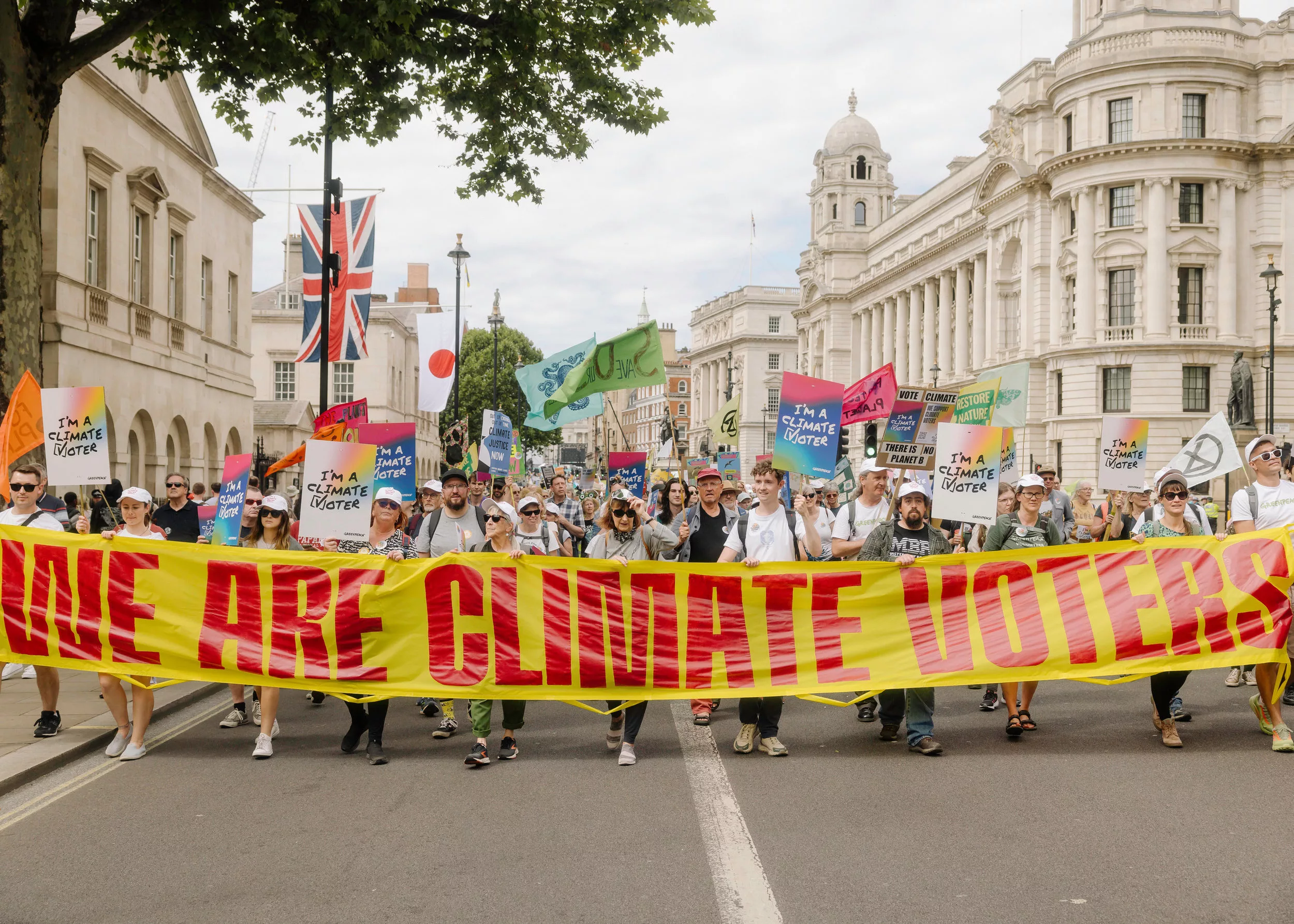
I am bathed in the warm glow of the righteous, for not only did I march with them, but I marched in the rain. Once you've made the decision, a little bit of meteorological adversity boosts everyone's sense of camaraderie. Apart, that is, from my fair-weather 'friend' Richard, who buggered off to the pub about ten minutes in, and is therefore the worst sort of part-timer and highly deserving of public contempt and derision. I try to do my bit.
So, apart from Richard the faithless, we were all there to send a message to Bali, where our glorious leaders are trying to save us all from climate Armageddon without imperilling the ability of large companies to make more money. Fortunately, climate change was recently reclassified from environmental disaster to business opportunity. Phew.
Read more »The real solution to climate change
Posted by bex on 3 August 2007.
We recently launched a new film about the real solution to climate change (clue: it's not nuclear power - and the film explains exactly why not). The film's been sent to every MP in the country and is making its way around the interweb nicely. But we think its message - that the UK needs a new, and sane, energy system now - is crucial and we want to push it out further. So we've produced this new trailer.
There are plenty of ways you can help us get the word out: write to your MP asking them to watch the film; embed the film or the trailer on your website, blog or MySpace page; send it to a friend; Hugg it, Digg it or add it to your StumbleUpon favourites.
Climate change is happening. We know exactly what needs to be done to stop it. The technologies already exist. Let's do it.
Case study: Green Park, Reading
Every year, millions of people drive past an 85 metre turbine on the M4, on the outskirts of Reading. The wind turbine, which supplies the many large businesses in the Green Park commercial estate and over 1000 homes, is one of the very few truly urban wind turbines in the country.