- Press Release
Developing countries on the front line of deep sea mining stand to gain almost nothing if mining goes ahead – new independent analysis

Mechanisms proposed by the International Seabed Authority (ISA) for sharing any future revenues from deep sea mining fundamentally fail to demonstrate equitable distribution, calling into question one of the fundamental premises on which attempts to justify mining are based, new analysis shows.[1]
The research by legal professor Dr Harvey Mpoto Bombaka and development economist Dr Ben Tippet, reveals that proposals currently under consideration would leave developing nations with meagre, token payments from deep sea mining. This configuration is in contrast to the clear United Nations Convention on the Law of the Sea (UNCLOS) mandate that mining must only be carried out for the benefit of humankind as a whole.[2] The real beneficiaries, the research shows, would be yet again a handful of corporations in the Global North.
Dr Harvey Mpoto Bombaka, Report Author, Centro Universitário de Brasília said: “What’s described as global benefit-sharing based on equity and intergenerational justice increasingly looks like a framework for managing scarcity that would deliver almost no real benefits to anyone other than the deep sea mining industry. The structural limitations of the proposed mechanism would offer little more than symbolic returns to the rest of the world, particularly developing countries lacking technological and financial capacity.”
The analysis, commissioned by Greenpeace International, shows that under a scenario where six deep sea mining sites begin operating in the early 2030s, the revenues that states would actually receive are extraordinarily small.
Using proposals submitted by the ISA’s Finance Committee between 2022 and 2025, the returns to states barely register in national accounts. After administrative costs, institutional expenses, and compensation funds are deducted, little, if anything, remains to distribute.
By contrast, the private sector would capture the overwhelming share of economic value. While net profits for private companies are not assured, given the high capital and operating costs of deep sea mining, the report illustrates a structural asymmetry. Private actors internalise the upstream value, while public benefits remain narrow, uncertain and deferred.
Ruth Ramos, Deep Sea Mining Campaigner, Greenpeace International said: “What Global South governments are being promised amounts to little more than scraps — nowhere near enough to justify tearing open the deep sea. Meanwhile, the environmental costs are pushed onto all of us. Deep sea mining companies are pushing an untested industry that would pocket the gains while offering frontline nations only symbolic crumbs in return. African countries, for example, stand to receive less than 0.5% of royalties. Revenue projections for many countries are equivalent to around 0.001% of their respective GDP. A whole country receiving the same payment as an individual CEO in a wealthy country is equivalent to a rounding error, and an insulting echo of extractivist colonialism.”
Pacific Island States, representing the Small Island Developing States (SIDS) in the region where deep sea mining exploration is most advanced, stand on the frontlines of this emerging industry. However, the report shows the average Pacific Island State is expected to receive US$46,000 per year in the medium term. As the area where deep sea mining is poised to begin, they are also among the nations that would bear its impacts most severely.
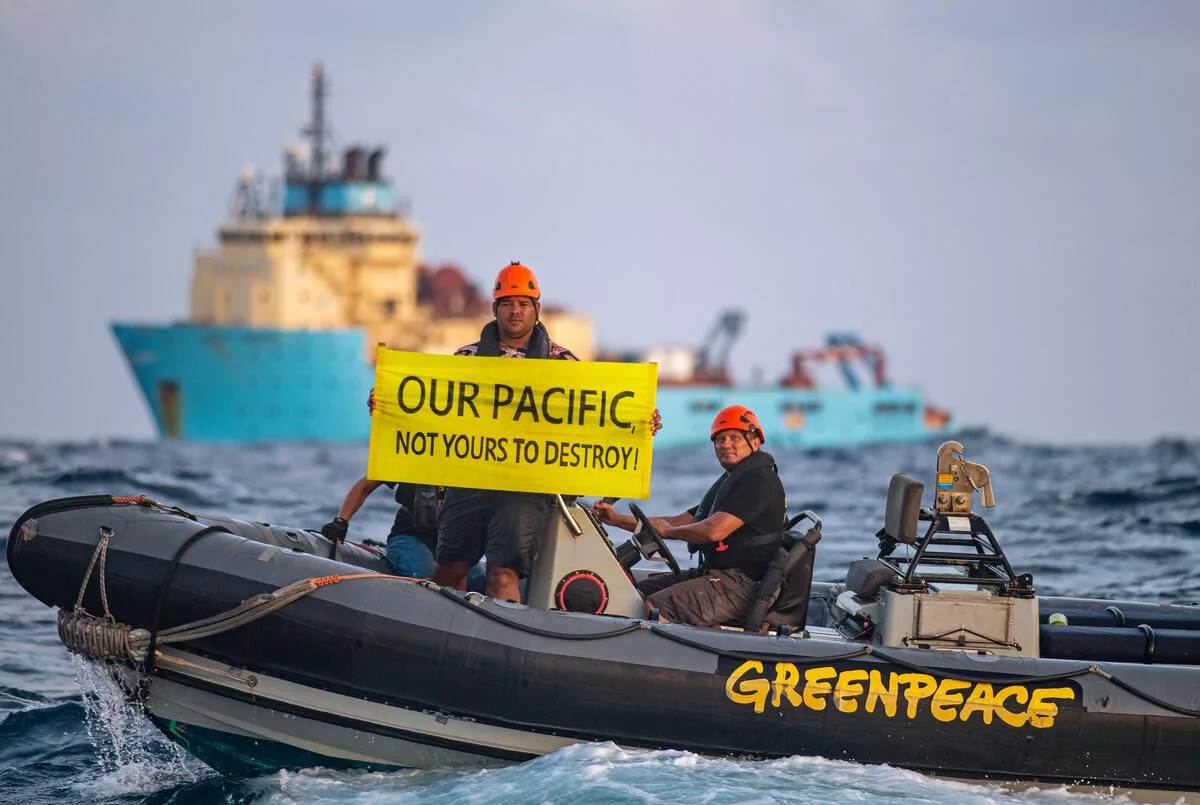
Shiva Gounden, Greenpeace Australia Pacific, Head of Pacific said: “The people of the Pacific would sacrifice the most and receive the least if deep sea mining goes ahead. We are being asked to trade our spiritual and cultural connection to our oceans for almost nothing in return, risking our livelihoods and food sources. The sacrifice for the Pacific is too big to give the green light to deep sea mining. Our Pacific Ocean is not for sale. Protecting this with everything we have is not only fair and responsible but our ancestral duty. The only equitable path is to leave the minerals where they are and stop deep sea mining before it ever begins.”
The international seabed is the common heritage of humankind and governments must act quickly to enact a moratorium.
ENDS
Photos are available in the Greenpeace Media Library
Report authors: Dr Harvey Mpoto Bombaka of the Centro Universitário de Brasília and
Dr Ben Tippet of King’s College London – author profiles available in the report.
Notes
[1] Equity, Benefit-Sharing and Financial Architecture in the International Seabed Area
[2] A key condition for governments to permit deep sea mining to start in the international seabed is that it ‘be carried out for the benefit of mankind as a whole’, particularly developing nations, according to international law (Article 136-140, 148, 150, and 160(2)(g), the UN Convention on the Law of the Sea)